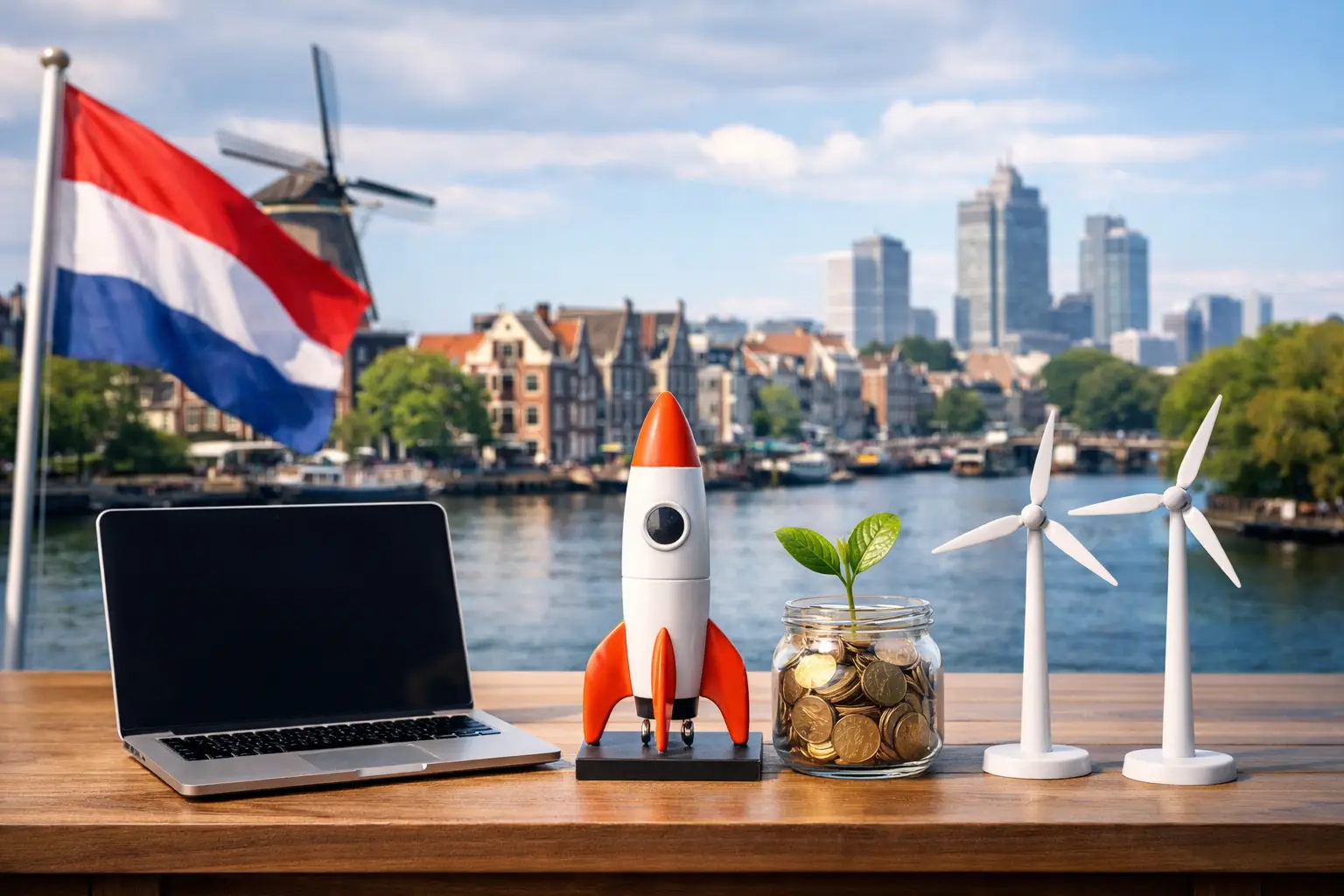
If you are building in Europe, the Netherlands keeps showing up for a reason. It is small enough to navigate quickly, international enough to scale from day one, and mature enough to give startups access to serious capital, research talent, and corporate buyers. That is why a Dutch startup ecosystem explained properly needs more than the usual list of unicorns and funding headlines.
What makes the Dutch market interesting is not just output. It is the mix. You have Amsterdam’s capital density, Eindhoven’s deeptech engine, Delft’s technical pipeline, Utrecht’s health and sustainability strengths, Rotterdam’s logistics and industrial backbone, and The Hague’s policy and cybersecurity relevance. For founders and operators, that creates a startup landscape that is connected rather than concentrated in one dominant city.
Dutch startup ecosystem explained: what it actually is
The Dutch startup ecosystem is the network of founders, investors, universities, accelerators, government programs, corporates, talent pools, and support organizations that help new tech companies start and grow in the Netherlands. That sounds simple, but the Dutch version works in a distinct way.
First, it is internationally oriented by default. English is widely used in business and tech, which lowers the barrier for cross-border hiring, investor conversations, and market expansion. Many Dutch startups build with Europe in mind from the start, not just the domestic market. That matters because the Netherlands alone is rarely a large enough end market for venture-scale ambitions.
Second, the ecosystem leans heavily on collaboration. Universities, municipalities, incubators, and regional innovation agencies often play visible roles. That can be an advantage for founders in sectors like AI, climate tech, health tech, semiconductors, and cybersecurity, where access to research, pilots, and public-private partnerships can shape early traction.
Third, the ecosystem has a practical streak. Dutch founders are often described as direct, commercially aware, and efficient with resources. That can produce strong companies, but it also means the culture is not always as hype-driven as larger startup markets. The trade-off is clear: less theater, sometimes slower storytelling.
The key hubs and why each one matters
Amsterdam gets most of the global attention, and not without reason. It remains the most visible startup and venture hub in the country, with strong fintech, SaaS, AI, and consumer platform activity. Many investors, media players, and international operators are concentrated there. If you want density of meetings, events, and hiring reach, Amsterdam still has an edge.
But the Dutch ecosystem is not Amsterdam-only, and that is one of its strengths. Eindhoven is central to any serious discussion because of its deeptech and hardware profile. The region benefits from a powerful combination of engineering talent, high-tech manufacturing, and research infrastructure. Companies tied to chips, photonics, mobility, robotics, and advanced systems often fit naturally there.
Delft matters because technical talent matters. Its university pipeline has long fed engineering-heavy ventures, especially in climate, aerospace, robotics, and hard science applications. Utrecht is often underrated, particularly for health innovation, life sciences, sustainability, and platform businesses that value a central location and strong talent access.
Rotterdam brings a different energy. It is commercially grounded, shaped by logistics, trade, industry, and infrastructure. That gives it relevance for startups working on supply chain tech, energy transition, ports, mobility, and industrial software. The Hague adds another layer through cybersecurity, impact, and policy-facing innovation.
For women in tech and underrepresented founders, this multi-hub model can help. Opportunity is not tied to one scene or one social circle. Access still varies by network, of course, but visibility can be built across cities, sectors, and communities rather than through one narrow gatekeeper path.
Capital in the Netherlands: strong, but selective
Funding is one of the biggest reasons people look to the Dutch market. The Netherlands has a healthy venture presence, active angel networks, and public support mechanisms that can help close early-stage gaps. There is real momentum in seed and early growth, especially in sectors linked to software, sustainability, AI, and deeptech.
Still, the capital story needs nuance. The country performs well relative to its size, but founders often need to look beyond the Netherlands for larger later-stage rounds. That is common across Europe, yet it matters when companies move from local validation to international scale. A Dutch startup may secure early support domestically and then rely on London, Paris, Berlin, or US investors for bigger checks.
There is also a pattern many founders know well: capital is available, but not evenly accessible. Warm introductions still matter. Pattern matching still affects who gets funded. Women founders and founders from underrepresented backgrounds continue to face the same trust gap seen across wider European venture markets. So while the Dutch funding environment is credible, it is not automatically inclusive.
That is where ecosystem visibility matters as much as capital itself. Media, events, and community platforms shape who gets seen as fundable. For a brand like DutchTechOnHeels, that question is not side commentary. It is part of how the ecosystem gets built.
Talent, universities, and the international advantage
One reason startups choose the Netherlands is talent density. The country combines strong universities, technical institutes, multilingual professionals, and a workforce generally comfortable with international teams. For startups hiring product managers, engineers, growth marketers, data professionals, and operations talent, that is a real advantage.
The Dutch education and research base is especially important in deeptech. University spinouts, science parks, and technical collaborations create pathways for commercialization that are hard to replicate quickly. This is one reason the Netherlands punches above its weight in areas like semiconductors, health innovation, climate solutions, and industrial technology.
But talent is not a solved issue. Competition is intense, especially for senior engineering, AI, and product roles. Amsterdam can become expensive fast, and startups outside the largest hubs may need stronger employer branding to attract international candidates. Immigration pathways help, but policy changes and housing pressure can complicate hiring. In other words, the Netherlands is attractive for talent, yet not friction-free.
Policy, infrastructure, and why startups pay attention
Government plays a more visible role in the Dutch ecosystem than some outsiders expect. Public funding instruments, regional development agencies, innovation subsidies, and EU-linked opportunities all shape startup growth. For founders in regulated or research-heavy sectors, this can be a major advantage.
The country also benefits from physical and digital infrastructure that supports business growth. Strong transport links, high internet penetration, and proximity to key European markets make the Netherlands efficient for companies operating across borders. For logistics, commerce, digital services, and B2B scaleups, that efficiency is part of the pitch.
The trade-off is that regulation and administrative complexity can still slow things down. Founders may find incorporation straightforward but run into friction around hiring, compliance, procurement, or cross-border structuring as they grow. This is not unique to the Netherlands, but it is worth stating plainly. Friendly ecosystem branding does not erase operational reality.
What the Dutch startup ecosystem explained often misses
A lot of coverage focuses on funding rounds, exits, and startup rankings. Useful, yes, but incomplete. What often gets missed is who gets visibility, who gets invited into high-trust networks, and who is treated as a default founder.
The Dutch ecosystem has made progress on diversity conversations, but progress is not the same as parity. Women remain underrepresented in venture-backed leadership, technical founder visibility, and investor circles. There are strong communities and role models, yet representation still depends too much on who already has proximity to power.
That matters for the health of the ecosystem itself. If the same founder profiles get amplified, the market loses ideas, talent, and category insight. Inclusion is not a branding exercise. It changes what gets built, funded, and taken seriously.
For readers building careers in tech, this is the practical takeaway: the Dutch startup ecosystem rewards competence, international thinking, and network fluency. But it also rewards visibility. If you are a founder, operator, or investor, showing up matters. So does backing a broader set of voices than the usual circuit.
Where the ecosystem is heading next
The next chapter will likely be shaped by a few clear forces. AI is already reshaping startup formation and investment logic across the Netherlands, while climate and energy transition remain major areas of focus. Deeptech will continue to matter because the Dutch ecosystem has real technical depth, not just software ambition.
At the same time, the strongest companies will probably be the ones that combine local advantages with European scale from the start. The Netherlands is an excellent launchpad, but rarely the whole runway. Founders who understand regulation, talent mobility, and cross-border go-to-market will keep holding an edge.
If you want a useful way to read the market, think of the Netherlands as a high-functioning connector state for innovation. It is not the loudest startup scene in Europe, and that can make it easier to underestimate. But for people paying attention, that is exactly the point. The real opportunity often sits where the infrastructure is strong, the networks are active, and there is still room to make tech more representative than it has been so far.