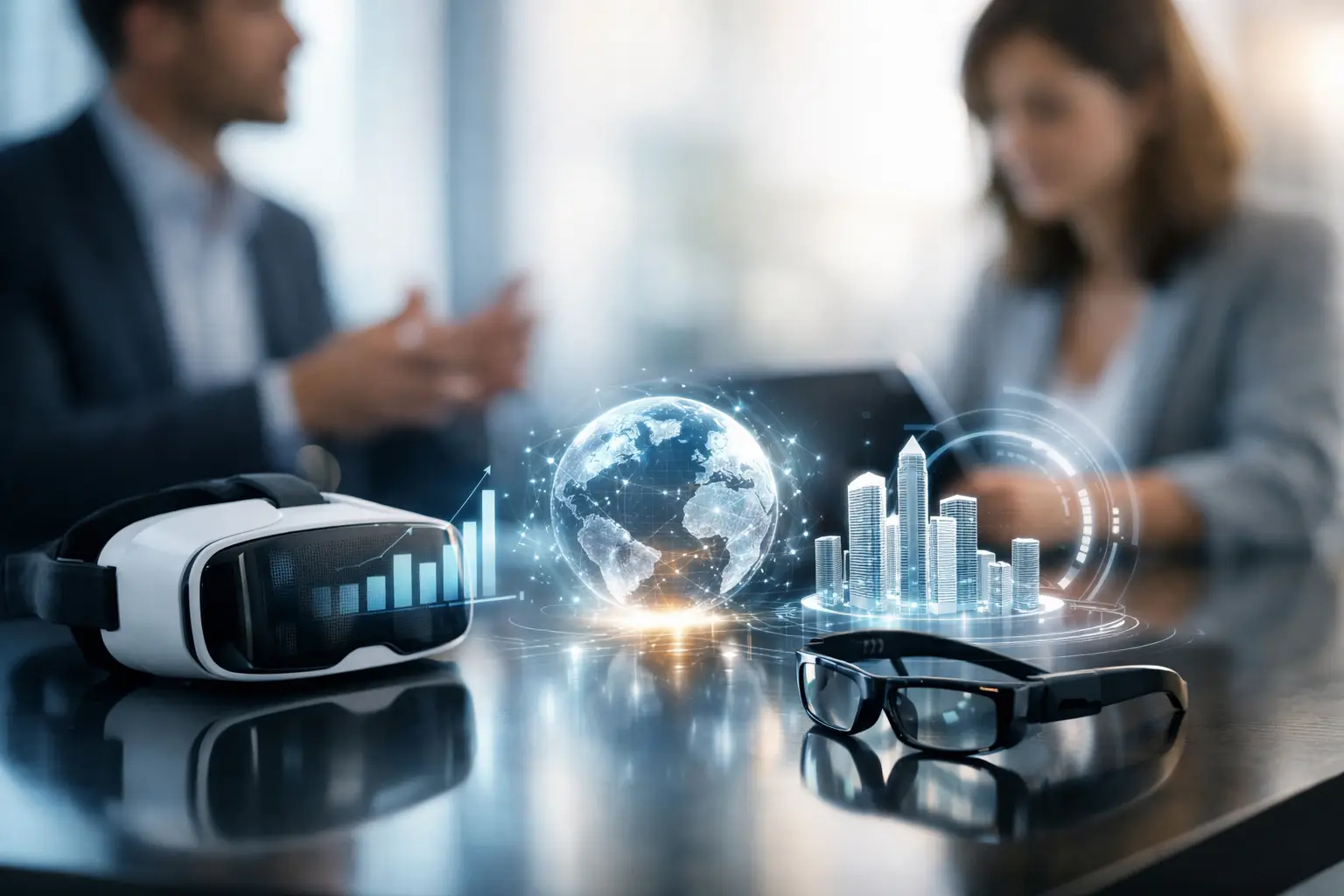
A year ago, most conversations about immersive tech still swung between hype and skepticism. Now the signal is clearer. The latest vr ar market trends show a market moving away from broad consumer promises and toward specific, measurable use cases - especially in enterprise, industrial training, healthcare, retail, and lightweight wearable computing.
For European tech professionals, that shift matters. It changes where funding goes, which startups get attention, what kind of talent is in demand, and how product teams should think about adoption. It also raises a familiar question in tech ecosystems that still struggle with representation: who gets to build the next computing layer, and who gets visibility while it takes shape?
The vr ar market trends that matter now
The biggest change is that virtual reality and augmented reality are no longer being judged as one shared category with one growth curve. Investors, operators, and buyers are separating them more clearly.
VR is increasingly tied to high-value, controlled environments. Think workforce training, design simulation, safety drills, and immersive collaboration where a headset can justify its cost through outcomes. AR, meanwhile, is broadening into several tracks at once: industrial overlays, smartphone-based experiences, and a longer-term push toward smart glasses that feel socially wearable.
That split is healthy. It removes some of the pressure for one breakout product to carry the whole sector. It also creates room for more grounded adoption. Not every company needs a metaverse strategy, but many do need better remote assistance, training, visualization, or field service tools.
In practice, the market is becoming less theatrical and more operational. That may sound less exciting, but for founders and teams building in Europe, it is usually where real traction begins.
Enterprise is still leading the revenue conversation
Consumer excitement gets headlines, but enterprise spending continues to anchor the category. Companies are buying immersive tools when they can shorten training time, reduce errors, improve safety, or support distributed teams without constant travel.
Manufacturing remains one of the clearest examples. VR is useful for onboarding workers into complex environments before they step onto a real factory floor. AR helps technicians access instructions, diagrams, or remote expert support while keeping their hands free. In logistics and healthcare, similar logic applies. If a headset or overlay improves accuracy or cuts downtime, the value proposition becomes easier to defend.
This does not mean enterprise adoption is simple. Procurement cycles are long, device management can be messy, and integration with existing systems is often where pilots stall. Still, the buying logic is stronger than in consumer entertainment because the benchmark is productivity, not novelty.
For startups, this creates a trade-off. Enterprise buyers offer clearer monetization, but they also expect reliability, compliance, and proof. It is not enough to build something visually impressive. Teams need to understand workflows, regulations, and change management.
Smart glasses are back, but expectations are different
One of the most watched vr ar market trends is the return of smart glasses as a serious product category. The difference this time is that the conversation is less about futuristic spectacle and more about form factor, context, and utility.
The market has learned that people will not adopt face-worn tech at scale just because the concept is advanced. Devices need to be light, socially acceptable, battery-efficient, and useful in short, repeatable moments. That is a much harder product challenge than putting screens near someone’s eyes.
This is where AR starts to look more promising than headline cycles suggest. Even before fully capable consumer glasses arrive, the ecosystem around them is maturing. Chips are improving. Display technology is getting better. AI is making real-time assistance more compelling. And developers are thinking more carefully about when visual overlays help versus when they distract.
For Europe, there is a real opportunity here in components, optics, enterprise software, spatial UX, and privacy-first design. The winners will not all be device brands. Many will sit deeper in the stack.
AI is changing the value of immersive products
If there is one force accelerating the category, it is AI. Not because AI makes every headset better by default, but because it makes immersive systems more responsive, personalized, and useful.
In training environments, AI can adapt scenarios to the learner’s behavior. In AR support tools, it can recognize objects, surface relevant instructions, and reduce the friction of navigating information. In design and 3D content creation, AI can help teams generate assets faster, lower production costs, and test ideas more quickly.
That matters because content bottlenecks have always slowed immersive adoption. Building high-quality 3D environments is expensive. Maintaining them is expensive too. If AI reduces that burden, more companies can experiment without committing to huge production budgets.
Still, there is a catch. AI can improve usability, but it also raises new concerns around data privacy, accuracy, bias, and workplace monitoring. In regulated European markets, those concerns are not side notes. They are product requirements.
Hardware is improving, but price pressure remains real
The market has better devices than it did a few years ago. Displays are sharper, passthrough is better, hand tracking is improving, and mixed reality experiences are less clunky. But hardware progress does not automatically solve adoption.
Price remains one of the biggest friction points, especially outside large enterprise budgets. Even when a headset is technically strong, companies still have to justify procurement, support, training, and replacement cycles. For consumers, the challenge is even sharper. Unless the everyday use case is obvious, many buyers still see immersive hardware as optional.
That is why ecosystem maturity matters more than raw specs. Buyers want to know whether devices will be supported, whether apps are stable, and whether there is a realistic path from pilot to scale. Hardware launches can create momentum, but retention depends on what people can actually do with the device next week, not just on demo day.
Europe has room to lead - if it plays to its strengths
The strongest European angle in immersive tech is not always pure consumer scale. It is the combination of industrial depth, design expertise, research capacity, and regulation-aware product building.
Europe already has sectors where immersive technology can be applied in practical ways: advanced manufacturing, automotive, health systems, logistics, architecture, defense, education, and cultural institutions. That gives startups and scaleups a real-world testing ground.
There is also a strategic opening around trust. As immersive tools collect more spatial, biometric, and behavioral data, privacy and governance become competitive differentiators. European companies that build with compliance and user trust in mind may move more slowly at times, but they can also build products that stand up better in enterprise and public-sector environments.
This is also where visibility matters. If the next wave of XR founders, product leads, and technical experts looks as narrow as the last major platform cycle, the market will repeat old patterns. Women in immersive tech are already shaping design, ethics, research, community building, and commercialization. They should be visible in funding conversations too, not only in event panels or diversity sidebars. That is not separate from market development. It affects what gets built and for whom.
Content, distribution, and user behavior are still unresolved
Even with stronger use cases, one challenge remains stubborn: distribution. Great immersive experiences are still harder to discover, deploy, and repeat than mobile or web products.
For consumer VR, content libraries often feel uneven. For enterprise AR, deployment can be fragmented across devices and workflows. For creators, monetization is still less predictable than on more mature platforms. These are not fatal flaws, but they do slow momentum.
The next phase of growth will likely come from companies that reduce this friction. Better developer tools, cross-platform workflows, easier content updates, and clearer onboarding could matter more than another round of abstract platform storytelling.
That also means the market may grow in a lopsided way. Some segments will accelerate quickly, especially where ROI is obvious. Others will remain experimental for longer. Anyone reading projections should keep that in mind. Big top-line forecasts often hide the fact that immersive tech is really several markets moving at different speeds.
What to watch next
Over the next 12 to 24 months, watch for sustained enterprise renewals rather than pilot announcements. Watch whether smart glasses move from curiosity to repeat usage. Watch how AI lowers the cost of building spatial content. And watch Europe’s role in privacy-first infrastructure, industrial applications, and specialist tooling.
For readers tracking career opportunities, this is also a moment to look beyond headset companies alone. Some of the strongest opportunities will sit in 3D workflow tools, AI layers, simulation platforms, enterprise deployment, UX research, and sector-specific applications.
The most useful way to read vr ar market trends right now is with discipline. Ignore the loudest claims and look at behavior: who is buying, who is renewing, which products solve routine problems, and which teams are building for real environments rather than idealized demos. The market is not waiting for one magical breakout moment. It is being built, quietly and unevenly, by people turning immersive tech into something practical enough to keep using.